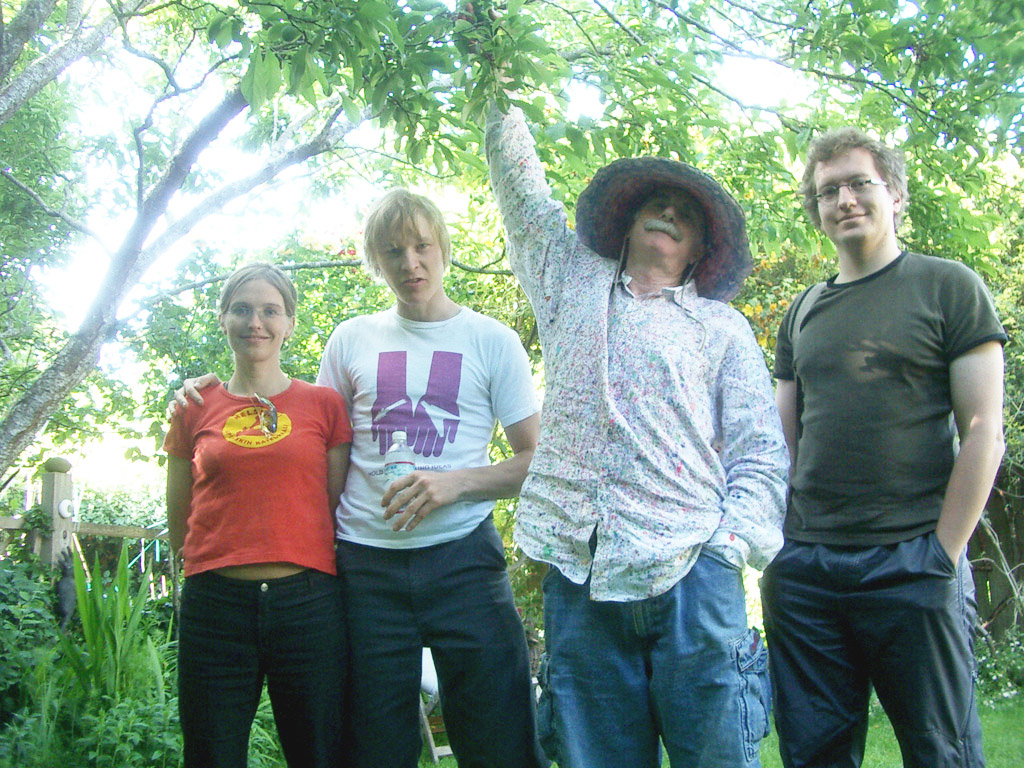
This blog is starting to take shape now that I’ve engaged the help of friends to transfer the content from its previous home at aula.cc/jyri here to zengestrom.com. I decided to set up a new home for my stuff when I began moving the Aula site in its entirety from our old custom-built PHP platform to MovableType. That migration is still not finished; so much material has accumulated at aula.cc over the years that sorting it all out takes time.
A few words about this new zengestrom blog: I wanted to have a personal and friendly, down-to-earth sort of blog space. That was how I briefed Mikko Hyppönen, my graphic designer friend. His design makes use of a sketched portrait, which is from the pen of Nene Tsuboi.
I’m quite excited about the result. Yet here I am refurbishing a very infrequently updated blog in good faith while the reality is that my waking hours (and I suspect a good slice of my sleep too) are spent processing a wholly different set of narratives that should materalize not as a blog, but as a PhD thesis. What’s up with that? Even William Gibson suspended his blogging when it was time to do serious writing. In the ‘last postcard from Costa Del Blog‘ he wrote:
I’ve found blogging to be a low-impact activity, mildly narcotic and mostly quite convivial, but the thing I’ve most enjoyed about it is how it never fails to underline the fact that if I’m doing this I’m definitely not writing a novel – that is, if I’m still blogging, I’m definitely still on vacation.
Being deprived of my blog right now would be akin to suffering extensive brain-damage. Huge swaths of acquired knowledge would simply vanish … my blog frees me up from having to remember the minutae of my life, storing it for me in handy and contextual form.
How to locate oneself in relation to these professional scifi dudes? In my case, the nature of academic writing has proven to be quite blog-averse. My research is about the work practices of real people in a corporation, often covering them to a degree of detail that is quite intimate. Although this ethnographic material is in digital format, it is not online; I’ve spent over two years collecting it in in the form of field notes, recordings, transcripts, photos and video clips, and cataloguing it into a searchable ‘outboard brain’ on my PowerBook. The reworking and eventual publishing of this material requires care and also a degree of anonymising. Alongside this I also occasionally give talks about the social aspects of technology, which sometimes make for good blogging. But I haven’t blogged about them much either. I suspect the silence has to do with a personal migration of a sort: I feel like I’m drifting into new space, but I don’t yet quite know what kind of stories live there. Recently I’ve noticed that a couple of my peers are experiencing similar drifiting. Maybe it’s a sign of the times.
Ulla and I were going to Khao Lak this Sunday to stay in a beach bungalow for two weeks. When I woke up to the news a few hours after the tsunami had hit and checked the travel agency web site, a news flash reported that Phuket had been damaged, but that Khao Lak had not suffered as badly.
As it turned out this information was false. Today the representative of the Finnish foreign minitry was quoted in Helsingin Sanomat, the main newspaper, saying that “Khao Lak in effect no longer exists.” Khao Lak now has the highest body count of all the Thai beaches.
In the midst of the chaos, the Finnish Raya Divers guys were going around finding survivors, helping them get medical treatment, and texting their names to Alex (a fellow Aula member) and a group of friends who run a diving weblog at sukellus.fi. While the ministry’s phone numbers were jammed by the volume of incoming calls from worried relatives, the sukellus.fi blog had information that was accessible and up to date. The hobby blog suddenly turned into a kind of Schindler’s list of survivors, and the number of daily visitors rocketed to hundreds of thousands.
To me it is a startling example of the power that ‘we media‘ can obtain in a crisis situation. It’d be interesting to hear what crisis management experts (for instance, folks working on The Information Technology and Crisis Management project) think about the sukellus.fi incident.
Update: On March 30th, 2005 Alex and the rest of the Sukellus.fi guys received the ‘State Prize’ (10,000 Euros) from the Finnish Government for ‘Fast and up-to-date sharing of information about the boxing day catastrophy in South-East Asia.’ In less than a week’s time, the pages served over 900,000 visitors.
Christian took us to see the Light Vests at the Cyberdog store in London today. They’re really neat. The basic design is a black shirt with a postcard-sized passive-matrix display velcroed on the front. They show various looping animations in all flavors of psychedelia. The high-end model titled “Light Red Alert Vest” in the online store (unfortunately made with Flash so I can’t link to it directly) allows you to type in a custom message to a scrolling LED display (think Joi’s hecklebot). The designer calls himself Lightmaster. He offered to make a custom one for me, complete with PC software to personalize it. With an 802.11 radio it could, for instance, display images going by on the wireless network Etherpeg-style.
TheFeature.com has an article by Howard Rheingold on mobilities research at Lancaster. I’m quoted near the beginning on my research on the RFID phone, which is one of the ventures that I’ve been studying at Nokia over the past two years. The discussion started when we met on May Day at Howard’s with Aleksi, Ulla, and Justin and the five of us hiked up Mt. Tamalpais for views of the ocean. Justin blogged the hike.
Back in Lancaster, working intensely now on the scraps of notes, fragmented narratives, fuzzy ideas, whatever there’s to go on in the general direction of a PhD thesis. Yet it’s June, and there’s always much happening in June: local Lancaster highlights include the Interface workshop (starting today!) and the What’s Life Got to Do with It symposium. I’m also hosting the Word in Edgeways lunch next Tuesday; I’m planning to discuss the technologies of ethnography there. I’ll miss the EVA party in Helsinki (featuring Joi Ito and Jorma Ollila among others). Steve Woolgar’s organizing an interesting workshop titled Does STS Mean Business over at Oxford later this month, which I am planning to attend. One last thing: up until now I purposefully haven’t blogged about the substance of my PhD research, but might start to experiment in that space… still need to do some thinking on that.
Some time ago I blogged about friendships that “dry out”. But there’s also the reconnecting, when you pick up from where you once parted with a person or an art.
Over the weekend I went skateboarding for the first time this season in Helsinki. Going up for a move there’s this instant when one realizes that it’s too late to turn back. Then: Thud! On landing the reflexes kick in and it’s either a complete mental and physical reunion with the knowledge of the board’s behaviour – or a painful encounter with the concrete pavement.
Which brings up the Dreyfusian observation that virtuosity (what Dreyfus calls the stage of expertise) has to do with this uncodifiable capability to connect with the world and be one with whatever one is practicing: to take something mundane like riding a piece of plywood (or preparing food, booking meetings, whatever) and turn in into a form of art. What would it mean to apply that attitude to one’s entire lifestyle? Introducing the skater ethic :)
Well, I’m back in Lancaster after a really strange christmas vacation in Cuba, which felt like a leftover chunk of soviet russia lost in the Caribbean. “Matkailu avartaa”—traveling opens the mind—goes a Finnish saying. Not only to the faraway things, but also to those subtle discrepancies in one’s home environment that normally go unnoticed. Like how annoying it is to search for a decent place in Helsinki to log on and do email. Just as annoying as in Havana, not to mention Lancaster where the café by the castle just shut. The spots keep changing. How to keep track?