life

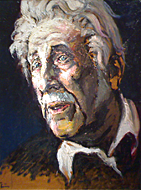
At age 15 I moved to Helsinki to study at a gymnasium specializing in fine art. My family remained in California, and relatives lived outside the city except for grandfather Georg, a recently widowed painter.

He lived in a cobwebbed apartment on the top floor of a Jugend fortress built during the Russian era. The building looked confidently over the officers’ casino on the frozen bay as if it was expecting the imperial schooner to dock shortly at its feet, and Alexander the Blessed to hop ashore and claim back his old Grand Dutchy. He had an excellent library, which could only be accessed using a ladder so as to not disturb the dust (which, if it got in the air, could have been deadly to the asthmatic inhabitant).

Grandpa Georg tutored me in languages and the history and philosophy of art. I studied Swedish conjugations late into the night with the help of strong black Caravan tea in his studio, and accompanied him on morning excursions where he taught me his methods of ”people-snapping” (quick sketches on café napkins with a felt tip pen) and painting aquarelle landscapes in any weather. Although he and I inhabited different centuries (the sight of him in public without a decent black tie would have been scandalous), we were both rather lonely, and I began to genuinely value the company of the gruff old aristocrat.

More than anything he was intellectually preoccupied with the notion of beauty. He held beauty to be a value on its own, saw it originating in nature, and considered its reverence a precondition to ethical human discourse and politics. The task of the artist was to be the intermediary who raised in his audience an awareness of beauty where none was apparent – within unremarkable landscapes and unappreciated members of society – and thus a sensibility for the subjects’ worthiness. Although he disliked Heidegger, he was closely aligned with phenomenology in emphasizing intentionality (consciousness being always about some external object) and, through the craft of painting, the portrayal of the world as it presented itself to the eye, as free of presuppositions and intellectualizing as possible.

Speaking about his teacher, the early 20th-century Russian painter Valery Semenoff-Tianchansky, he says:

”When I think about Valery Semenoff-Tianchansky, and what he, an old man, meant when he exclaimed: ”Look! Just look at that field!” It may have been wheat growing, or perhaps rye – it was the color of bronze, and quite spectacular. He said: ”There is nothing more beautiful in existence.” His friend Picasso — he said Picasso could not have painted that. And indeed Picasso couldn’t. Because no man is capable of painting it. We can only adore it, and try to teach others to revere it too. ”

The full 8 1/2-minute interview is below.

Painter Georg Engeström a.k.a. GEM (1921-2008) reflects on his life’s work and the role of the artist as an intermediary between man and nature. This interview was recorded at his summer home in Finland shortly before the opening of his 85th anniversary exhibition. Although GEM applied a range of methods (he studied the fresco in Italy and spent five decades as a political cartoonist), and painted thousands of portraits during his 70-year career, he is still mainly known as a landscape painter. His work was influenced by Goya, Turner, and – more than any other – the Russian master Ilya Repin (he was born in Repin’s home village). He passed away in 2008.

Ulla and I are heading stateside today. We’ll be in New York tomorrow, at FOO Camp in Sebastopol this weekend, and in the San Francisco Bay Area next week. We’ll stop in NYC again on Saturday 2 Sep on our way back to Helsinki.

Anyone in SF or NYC area ping me on email/SMS if you’d like to hook up.

I just booked flights to San Francisco and Seattle, leaving on Friday. Ulla is going to launch the Thinglink beta at Maker Faire on Saturday. Coolio!

Ulla booked us a room at this wacky hotel in San Francisco for the weekend. I don’t know where we’ll stay after that. On May 5th we’ll go to Seattle and attend MSR’s Social Computing Symposium.

I have very little planned so let me know if you want to meet up to talk biz, go skateboarding, debate social theory or just hang out in the Bay Area next week or the following week.

I did something that sounds completely nuts. I resigned from my position at Nokia Multimedia after just six weeks. That so because it turned out unfeasible to do what I consider sensible there. Better to acknowledge it in good spirit. There are some good people there and we remain friends.

Guess it’s time to try and make meaning.

On March 1st I joined Nokia as Senior Product Manager, Internet Handhelds. I’m based in Helsinki. In Nokia’s org I work in the Convergence Products Business Program, which is part of the Multimedia group.

I’ll be responsible for the development of new Nokia products based on the open source Linux software architecture developed for the Nokia 770 internet tablet.

Analysis on Nokia’s Convergence Products act in Business Week last month:

One way or another, the 770 is a sharp break from Nokia’s past that points the way to a dramatically different future.

Here’s a link to the article.

Seems that life as an all-in-one Nokia intrapreneur, web startup guy, and PhD student will continue until christmas and so I’ll continue not blogging quite so intensely. If all this stuff emerges in good shape I could suddenly have quite a bit to say. In the meantime, here’s a quick update on what’s new.

– Last weekend was DesignEngaged in Berlin. It was a lot of fun – best bit being the Saturday scavenge around Berlin, organized by Mike Kuniavsky, which wasn’t really over until I woke up on the couch in Schulze’s and Webb’s crib somewhere in Friedrichshein. Many people including myself were sort of in between things, where the new stuff wasn’t quite yet ready. But there were many very refreshing notes too. In addition to all the good conversations, the higlights included Nurri Kim’s fabulous photoset on the usage of blue tarps in Japan, Adam Greenfield on the ruin of civilization that bases on high energy consumption, Chris Heathcote on fabrication, and Jack Schulze turning solid into liquid.

Malcolm McCullough gave a nice Aula talk in Helsinki last night on his latest book, Digital Ground. Thanks to everyone for showing up. It was good to be reminded that Helsinki continues to be the scene of choice for sharp, subtle, focused people who are changing things.

– Next weekend I’ll speak at Bloggforum in Stockholm. This seems to be shaping up into quite a noteworthy event, and I really look forward to picking the brains of all the super-savvy Stockholm bloggers.

– The weekend of Nov. 26 I’ll be in Huddersfield, UK as Ulla talks craft and product codes at Ultrasound. Looking forward to touching base with the artists and hackers who’ll present there.

It’s crunch time with the PhD thesis (hence the pause with the blog). Nokia’s keeping me busy in the daytime so both ends of the candle are ablaze and in all honesty I don’t know how long I’ll be able to keep this up. The good news is I just finished Chapter 4. And had an entertaining dinner with Ben Hammersley. He’s going to speak on RSS tomorrow at Nokia House in the Speaker series organized by Stephen Johnston. If there, rush to attend. Ben and I will both also be speaking at Bloggforum in Stockholm on November 19th.

It was great to meet everyone at the James Martin Institute, and like I was hoping the feedback I got from the talk was extremely useful. Indeed I rewrote the outline of the thesis on the plane to Helsinki. JMI is only a year old, and I have the feeling it could become a place of note in social studies of science and innovation in the years to come. Thanks to Christian for being such a first-class host, to Sam for arranging my stay at New College, and to everyone for the discussions.

The stay in Oxford also marked the end of my residence in England. I’m moving home! Feels great, even though I have no idea how long (or where) I’ll stay in Helsinki.

Someone stole my poster during the night from the locked SSIT5 display at LSE. It’s got the link to my blog printed on it, so dear perpetrator, know this: I’ve made the trip to London to present that poster, and I spent a lot of time preparing it. Thanks to you I’ve missed the opportunity to display my work to the other academics here this morning. I wrote on the poster: ‘I’d love to get feedback, so please come talk to me if you find this interesting.’ That does not translate to ‘you can take this poster home with you!’ I hope it reappears upstairs before the afternoon’s PhD students’ session starts.